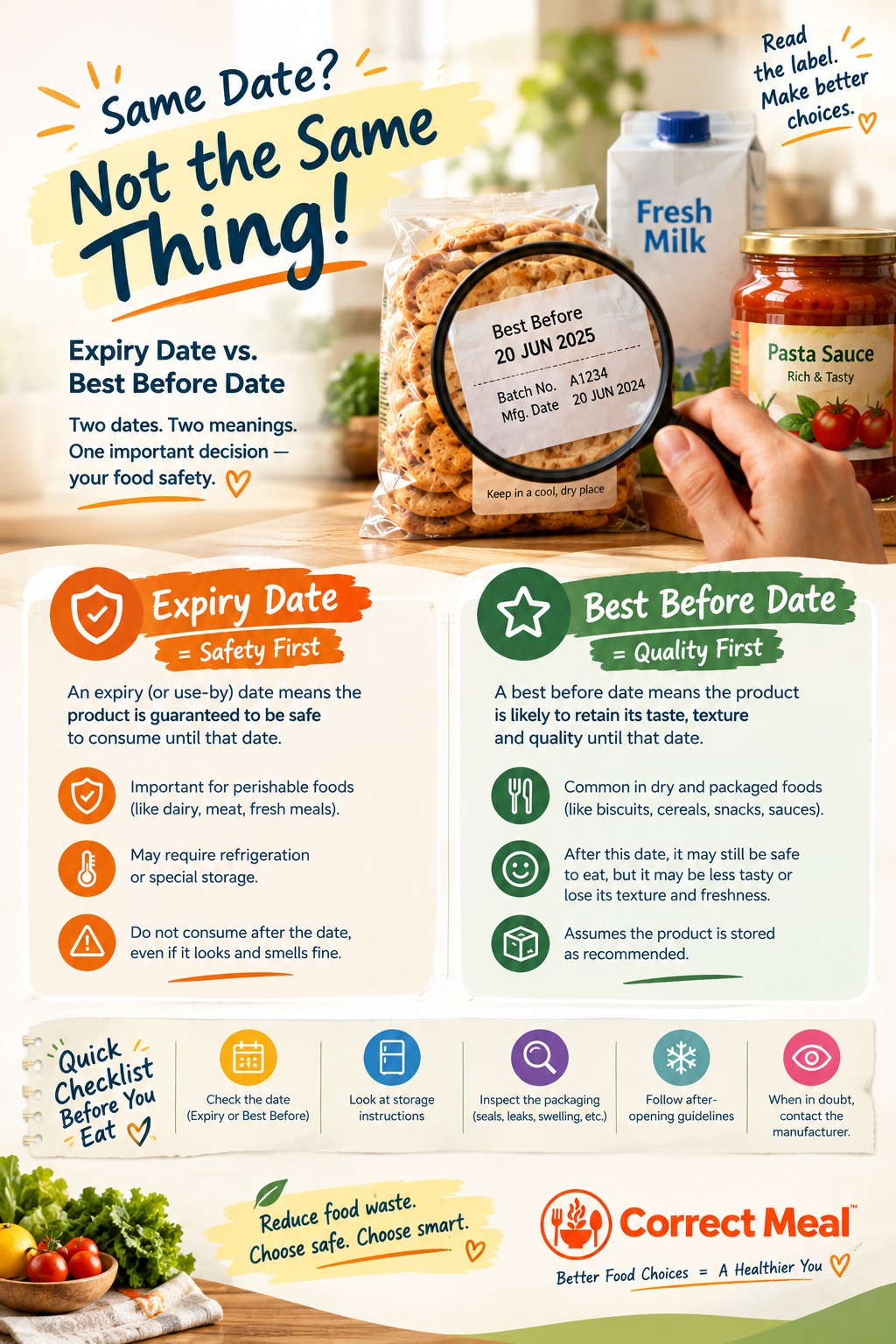
The difference between an expiry date and a best before date is not always obvious. In fact, it’s a bit of a grey area in some cases. An expiry date is the date until which a product is guaranteed to be safe to consume. A best before date is the date until which the product is guaranteed to be at its best in terms of flavour and quality.
Have you ever picked up a packet of biscuits, a milk carton or a jar of sauce and wondered whether it’s still OK to eat after the date on the packet?
You’re not the only one to use the terms ‘expiry date’ and ‘best before date’ as if they’re the same thing. They don’t necessarily mean the same thing at all. Knowing the difference can go some way towards helping you make better food safety decisions and reducing food waste.
So, what is the difference between an expiry date and a best before date? Let’s look at what these dates mean, what you should be checking before you eat your packaged food and how you can read food labels more carefully.
What is an expiry date?
An ‘expiry date’ (usually ‘Expiry’ or “Use By”) is the date by which a food product is permitted to be used under the conditions for which it was intended.
In India, food labelling is regulated by the FSSAI via the Food Safety and Standards (Labelling and Display) Regulations, 2020 and the various amendments to those regulations.
Consumers should take an expiry or use-by date very seriously and adhere to the instructions on the pack. You should not assume that a product is safe to eat after the date has passed just because it looks and smells fine.
For example, a packaged food product may require refrigeration in order to be safe and fit for consumption throughout its stated shelf life. If it’s stored incorrectly, it can go off prior to the printed date.
Remember: Always check the date, the storage instructions and the condition of the pack before you consume a product.
What does ‘best before’ mean?
It’s a rather confusing label to have on a product. It doesn’t mean that the product is unsafe to eat after that date. It simply means that the product will be at its best (in terms of flavour, texture, etc.) up until that date. After that date, it may still be safe to eat, but will probably be less tasty.
A best before date generally means the period during which the product is expected to be at its best, assuming it’s stored as recommended.
Quality encompasses all the usual things we think about: taste, texture, aroma, freshness and crispness. All of these can change over time even in the case of a food which may not appear to be spoiling at all.
Biscuits can go from crisp to crumbly, breakfast cereals can lose their crunch, and certain packaged snacks can gradually lose their original flavour.
A best before date is not necessarily the same as an expiry date. It should not be interpreted as a date after which you can safely consume the food. The food itself, the storage conditions, the packaging and the label instructions all have a bearing on this.
Expiry Date vs. Best Before: Key Differences
The key difference between a “best before” date and an “expiry” or “use by” date is food quality versus safety. A best before date indicates how long a product is likely to retain its taste, texture and freshness when stored properly. An expiry or use-by date, however, may have important food safety implications and should not be ignored.
For example, biscuits may lose their crispness over time, while perishable foods can become unsafe if stored incorrectly. The meaning of these dates depends on the product and applicable regulations. In India, the Food Safety and Standards Authority of India (FSSAI) official FSSAI Labelling and Display Regulations and Amendments set requirements for date labelling on packaged foods. Consumers should always check the full product label and follow the recommended storage and consumption instructions.
Can you eat food after its best-before date?
The answer is, of course, going to be different depending on the food and how it’s been stored.
Some appropriately stored shelf-stable foods will actually maintain acceptable quality past their best-before date. That doesn’t mean that all food is safe to eat after the date has passed.
Before you make up your mind, consider the type of food, the storage conditions and the condition of the packaging. Dry packaged foods and very perishable foods will have very different storage and safety requirements. A product stored at the wrong temperature will go off sooner than it otherwise would.
Watch out for damaged seals, leaking packs, swelling, visible mould, odd odours or any kind of change in texture. Those are all signs that the product shouldn’t be eaten.
Don’t taste food to assess its safety. Harmful microbes can be present without any change in smell, appearance or taste.
The USDA Food Safety and Inspection Service guide to food product dating makes it clear that a large number of date labels in the US are quality dates rather than safety dates (with the notable exception of infant formula). It’s good general guidance, but you wouldn’t necessarily apply US labelling practice to Indian products.
What happens if you eat food past its expiry date?
Eating food past its ‘best before’ or use-by date can be risky, of course; it all depends on the food in question, how it’s been stored and the actual requirements.
Perishables can support the growth of bacteria if stored incorrectly. Some of the bacteria that can cause illness don’t actually cause any visible change in the food, so you can’t rely on appearance to tell you whether or not it’s safe.
This is especially the case with foods that need to be refrigerated or have specific storage requirements.
For instance, if a product has “Keep Refrigerated” or “Refrigerate after opening” on it, that’s part of its safe use instructions. It could be unsafe to leave it at room temperature for any length of time, irrespective of the date on the pack.
If it’s past the expiry or use-by date, then don’t rely on smell, taste or appearance to tell you it’s safe.
How to Read Food Labels Correctly?
Reading the whole label rather than just checking one date can go a long way to helping you make a better decision.
Check the date marking. Look for the manufacture or packaging date and the expiry/use-by or best-before date as appropriate.
Read the storage instructions. Check whether the product requires refrigeration, freezing or storage in a cool, dry place.
Follow instructions after opening. Some foods have a shorter usable life once the pack has been opened, even if the printed date hasn’t expired.
Check the packaging. Look out for products with broken seals, leaks, any swelling, etc.
Check the manufacturer’s guidance if in any doubt. If the date is unclear or you’re not sure about the storage history, then get in touch with the manufacturer rather than attempting to work it out.
FSSAI’s How to Read Labels Guide is another useful resource.
How can you reduce food waste without compromising safety?
The most obvious way to reduce food waste is simply to buy only what you need. This straightforward approach will also save you money. It is a matter of planning your purchases and only buying what you actually require. It is also a good idea to check your fridge regularly and get rid of any food that is going off.
Confusion over food dates can lead to people throwing things away that are perfectly fine. A few simple habits can go a long way to help you manage your groceries.
- Organise your pantry (put the older stuff at the front so you do actually use it first).
- Plan your shopping. Buy the quantities you can reasonably use prior to the relevant date.
- Store food correctly (follow the label instructions and store at the correct temperature).
- Label the opened packages (record the opening date if this is helpful, particularly where there are specific after-opening instructions).
- Don’t go to the bother of eating a product just to avoid waste if it’s past a safety date or has been stored incorrectly.
Reducing food waste is important, but food safety must always be the priority.
Final Thoughts
Understanding the difference between an expiry date and a best before date will help you make better decisions about the food you buy, the food you store and the food you eat.
While a best before date generally indicates expected quality, an expiry or use-by date has to be considered in the context of relevant food safety requirements. A food’s appearance and expiration date don’t tell the whole story; storage conditions, packaging, and the nature of the product also play critical roles.
Make it a habit to read the label, follow storage instructions and avoid taking unnecessary risks with food of uncertain quality.
At Correct Meal, we believe that better food choices begin with better food safety awareness.
Lorem ipsum dolor sit amet, consectetur adipiscing elit. Ut elit tellus, luctus nec ullamcorper mattis, pulvinar dapibus leo.