High in the hills of West Bengal, surrounded by mist, steep slopes and Himalayan air, lies one of India’s best-known tea-growing regions: Darjeeling.
The tea produced here became famous far beyond India. Its story is closely connected to the region’s geography, the development of tea cultivation in the 19th century, careful production methods, and eventually a system of legal protection that made the name Darjeeling internationally significant.
The Beginning of Tea in Darjeeling
Tea cultivation in Darjeeling began in the 19th century. Tea Board India records that tea was first planted in the region in the early 1800s, while its international documentation places organized cultivation in certain Darjeeling gardens at around 1835.
The region turned out to have conditions particularly suited to tea. Tea gardens are located at elevations ranging from approximately 600 to 2,000 metres, with cool temperatures, rainfall, mist and mountain terrain contributing to the character of the tea.
Why Does Darjeeling Tea Taste Different?
Darjeeling tea isn’t famous simply because it comes from India.
Its distinctive character is strongly connected to where it is grown.
The combination of altitude, soil, climate, rainfall and processing creates characteristics that Tea Board India associates specifically with tea produced in the Darjeeling region.
This is one reason the name of the place became so important.
The tea gardens are spread across the hills, and the individual gardens themselves have become closely associated with the tea they produce.
The People Behind the Tea
Before a cup of Darjeeling tea reaches a customer, the process begins in the tea garden.
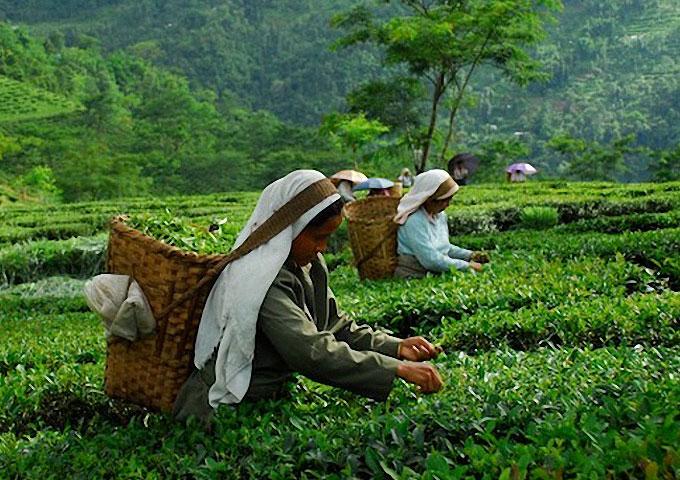
Tea leaves are traditionally picked by hand, with workers selecting tender leaves from the bushes. Tea Board India describes women tea pluckers beginning work early in the morning, often while the leaves are still covered with dew.
The steep terrain makes tea cultivation very different from farming on flat land. Rows of tea bushes follow the contours of the hills, creating the landscape that has become closely associated with Darjeeling.
From a Regional Tea to an International Name
As Darjeeling tea gained recognition, buyers outside India began associating the name with a particular taste and origin.
Tea Board India says Darjeeling tea has received international recognition for more than a century and that its reputation is fundamentally connected to its geographical origin.
This created an important problem: How could consumers know whether tea labelled “Darjeeling” actually came from Darjeeling?
The answer eventually involved geographical indication and certification.
Protecting the Name “Darjeeling”
Tea Board India developed a certification system to protect the name.
Under the system, genuine Darjeeling tea must come from registered tea gardens in the defined geographical area, be processed in the defined region, and meet the characteristic quality requirements associated with Darjeeling tea.
The Darjeeling word and logo were also registered as certification marks, while Darjeeling tea became one of India’s important geographical indications. Tea Board India describes the Darjeeling GI registration as the first geographical indication registered in India’s name.
This protection helped distinguish authentic Darjeeling tea from products using the name without coming from the region.
Why the Name Still Matters
Today, “Darjeeling” isn’t simply a description of a type of tea.
It identifies tea connected to a particular geographical area and production system.
Tea Board India states that tea produced outside the defined Darjeeling region cannot legitimately be called Darjeeling tea. Its certification programme is designed to protect both consumers and producers by maintaining the connection between the product and its origin.
From Himalayan Hills to Tea Cups Around the World
The journey of Darjeeling tea is ultimately a story about place.
The mountain climate created distinctive growing conditions. Tea cultivation developed in the region during the 19th century. Generations of workers continued the careful process of growing and harvesting the crop. And eventually, certification and geographical protection helped preserve the connection between the tea and Darjeeling itself.
That is why a cup of authentic Darjeeling tea carries more than a familiar name. It represents a product whose reputation has been built around the land, climate, gardens, people and history of the Darjeeling hills.