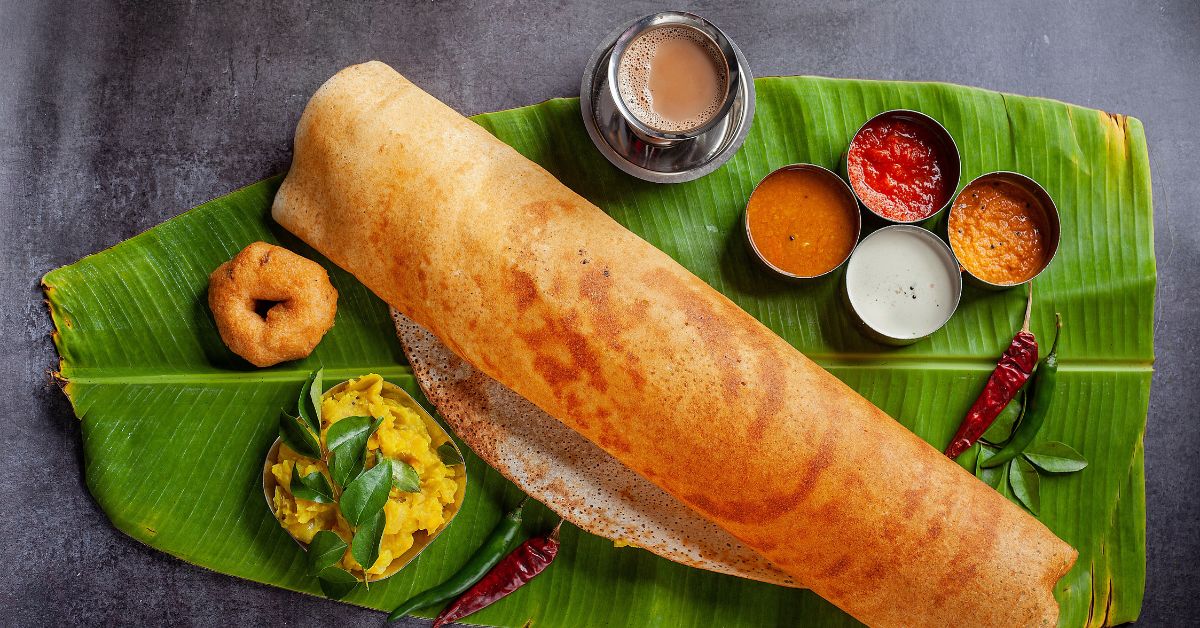
Few Indian foods have travelled as successfully across regional boundaries as the dosa. What was once strongly associated with South Indian kitchens is now a familiar sight on breakfast menus, railway stations, restaurants, food courts and homes across the country.
But dosa did not become an all-India favourite overnight. Its journey involved centuries of culinary evolution, migration, restaurants, and changing Indian eating habits.
An Old Dish With More Than One Origin Story
The exact origin of dosa is still debated.
Historical accounts connect the dish with South India, but there are different theories about where it first developed. One recent account in The Indian Express traces references to dosa back to 8th-century South India, while also noting that early versions were likely thicker than the thin, crisp dosas commonly eaten today.
Another theory connects dosa with Karnataka, where the medieval text Manasollasa, associated with King Someshvara III, contains a reference to a dish called dosaka. Other accounts connect its development with Tamil Nadu.
So rather than one simple invention story, dosa’s history appears to be part of a much longer evolution of rice-and-lentil cooking in South India.
From Traditional Dish to Restaurant Favourite
For centuries, dosa remained primarily a regional food. Its transformation into a dish familiar across India was helped considerably by the growth of South Indian restaurants.
One particularly important influence was the Udupi hotel.
These restaurants expanded beyond Karnataka and began appearing in cities around India during the 20th century. They initially served South Indian communities living away from home, but their food soon attracted customers from other backgrounds as well.
Dosa, along with idli, vada and other tiffin dishes, became part of the menu at these restaurants.
That gave people in cities such as Mumbai, Delhi and Kolkata an opportunity to try South Indian food without travelling south.
Migration Helped Carry Dosa Across India
Food often travels with people.
South Indian migrants who moved to other parts of India for employment, business and other opportunities brought their food traditions with them. Restaurants became an important way of introducing those traditions to a much wider audience.
A recent Indian Express feature on Indian breakfast culture specifically notes that Udupi Brahmin migrants helped spread dosa, particularly masala dosa, to cities such as Bengaluru and beyond.
The dish gradually stopped being something people associated only with a particular region.
Then Came Masala Dosa
One reason dosa became especially popular was its ability to change.
The plain dosa is relatively simple: fermented batter is spread across a hot surface and cooked until the desired texture is achieved.
But the addition of a spiced potato filling created masala dosa, which became one of the best-known versions of the dish.
The combination of a crisp dosa, seasoned potato filling, sambar and chutneys gave restaurants an easy-to-recognize meal that could appeal to customers unfamiliar with South Indian cuisine.

Dosa Arrives in Kolkata
Dosa’s journey is particularly interesting in cities far from South India.
In Kolkata, South Indian restaurants became part of the city’s food landscape decades ago. A 2025 Indian Express article recalling Kolkata’s food culture mentions restaurants such as Jyoti Vihar, where paper dosa and masala dosa were already familiar to diners.
This illustrates how the dish gradually became part of everyday urban food culture rather than remaining a regional specialty.
Railway Stations and Canteens Played a Role Too
Restaurants weren’t the only places spreading South Indian food.
South Indian food also became familiar to people through institutional kitchens and railway travel. Food historian Kurush Dalal told The Indian Express that South Indians working in the armed forces helped introduce foods such as idli and dosa into military messes, where people from different parts of India encountered them.
As people travelled more frequently around the country, regional foods increasingly crossed geographical boundaries.
Dosa Kept Changing
Another reason for its long-lasting popularity is that dosa is not just one recipe.
Different parts of South India developed their own versions.
There are rava dosa, neer dosa, set dosa, pesarattu, benne dosa, adai and many other regional varieties. Some are fermented, while others are prepared without fermentation. Ingredients and textures vary considerably between regions.
This flexibility allowed restaurants and home cooks to adapt the dish to local preferences.
The Benne Dosa Story Shows How Food Keeps Travelling
The journey continues even today.
Benne dosa, a buttery Karnataka specialty associated particularly with Davanagere, has recently gained attention outside Bengaluru. A 2026 Indian Express report described its growing presence in restaurants in Mumbai and Delhi.
That is another example of how a regional version of an old dish can travel to a new audience.
From South Indian Specialty to Indian Favourite
There is no single event that made dosa popular throughout India.
Its journey happened gradually:
South Indian culinary traditions → Udupi restaurants → migration → urban food culture → wider restaurant networks → regional adaptations → nationwide popularity
A 2017 survey reported by The Indian Express, based on Swiggy ordering data from five major cities, found dosa among the most-ordered breakfast dishes in Delhi, Mumbai, Chennai, Bengaluru and Pune.
Today, ordering a dosa in a city far from South India is completely ordinary.
And perhaps that is the most interesting part of its story: dosa became an Indian food not by losing its regional identity, but by carrying that identity with it wherever people took it.